
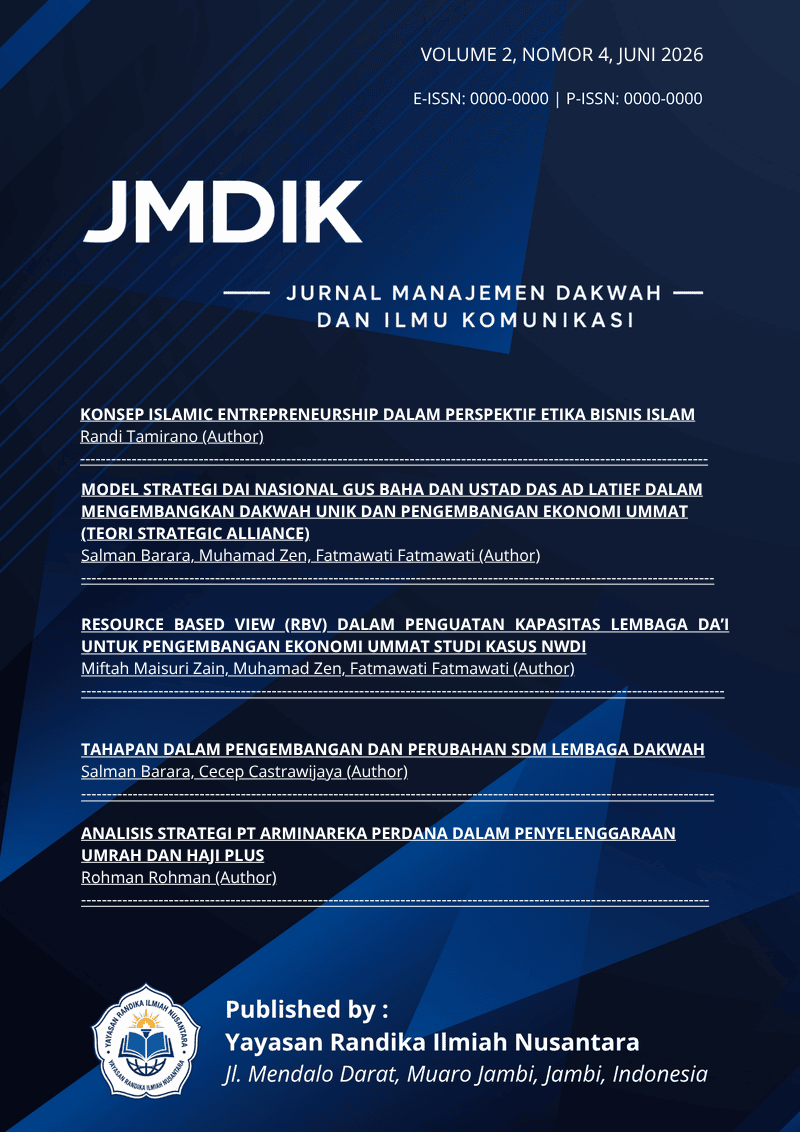
Model Strategi Dai Nasional Gus Baha dan Ustad Das Ad Latief Dalam Mengembangkan Dakwah Unik Dan Pengembangan Ekonomi Ummat (Teori Strategic Alliance)
Article Sidebar
Main Article Content
Abstract
The background of this research is based on social changes, the development of digital technology, and the complexity of the problems of the people who demand da'wah not only to function as a delivery of religious teachings, but also as an instrument of social, educational, and economic transformation. Therefore, a collaborative, adaptive, and sustainability-oriented da'wah approach is needed. This research uses a qualitative approach with the library research method, namely through the analysis of various literatures, scientific articles, and relevant sources related to the theory of the Strategic Alliance and contemporary da'wah. The focus of the study is directed to the basic concept of the da'wah strategy based on strategic alliances, Gus Baha's da'wah model with a cultural-intellectual pattern, and Ustadz Das'ad Latief's da'wah model with an emotional-entrepreneurial pattern. The results of the study show that the Strategic Alliance theory is relevant to be applied in the development of modern da'wah because it is able to build synergy between da'wah actors through network strengthening, resource collaboration, and competency integration. Gus Baha presents a da'wah model based on scientific authority, contextual approaches, and pesantren traditions that emphasize the deepening of religious understanding. Meanwhile, Ustadz Das'ad Latief developed a da'wah model that is communicative, persuasive, and close to the socio-economic reality of the community through an emotional and motivational approach. Both models show that modern da'wah requires a combination of intellectual strength, effective communication, and the ability to build social networks.
Downloads
Article Details
Section

This work is licensed under a Creative Commons Attribution 4.0 International License.
How to Cite
References
Ahmad, A. (1996). Dakwah Islam dan Perubahan Sosial. Yogyakarta: Prima Duta.
Ansell, C., & Gash, A. (2008). Collaborative governance in theory and practice. Journal of Public Administration Research and Theory, 18(4), 543–571.
Arifin, A. (2011). Psikologi Dakwah. Jakarta: Bumi Aksara.
Azra, A. (2012). Pendidikan Islam: Tradisi dan Modernisasi di Tengah Tantangan Milenium III. Jakarta: Kencana.
Barney, J. B. (2007). Gaining and Sustaining Competitive Advantage. New Jersey: Pearson Education.
Bryson, J. M. (2018). Strategic Planning for Public and Nonprofit Organizations. New Jersey: Wiley.
Chambers, R. (1995). Poverty and Livelihoods: Whose Reality Counts? Brighton: IDS.
Creswell, J. W. (2014). Research Design: Qualitative, Quantitative, and Mixed Methods Approaches. California: Sage Publications.
David, F. R. (2017). Strategic Management: Concepts and Cases. New Jersey: Pearson.
Fikri, Z., Afdhal, K., Pelangi, A., Pauzana, P. P., Sari, R. L., & Tamirano, R. (2025). Komunikasi Dakwah di Era Digital: Peran Radio Nurul Ilmi Jambi dalam Menyebarkan Nilai Islam. Jurnal Manajemen Dakwah dan Ilmu Komunikasi, 1(5), 286-300.
Fukuyama, F. (1995). Trust: The Social Virtues and the Creation of Prosperity. New York: Free Press.
Furqan, M., Ronaydi, M., & Tamirano, R. (2024). Pengaruh Menonton Video Dakwah Gus Baha Dan Ustadz Khalid Basalamah Terhadap Tingkat Religiusitas Pada Masyarakat. Qaulan Baligha: Jurnal Ilmu Manajemen Dakwah, 1(2), 123-144.
Hefner, R. W. (2000). Civil Islam: Muslims and Democratization in Indonesia. Princeton: Princeton University Press.
Hitt, M. A., Ireland, R. D., & Hoskisson, R. E. (2017). Strategic Management: Competitiveness and Globalization. Boston: Cengage Learning.
Ilaihi, W. (2010). Komunikasi Dakwah. Bandung: Remaja Rosdakarya.
Kaplan, R. S., & Norton, D. P. (1996). The Balanced Scorecard. Boston: Harvard Business School Press.
Khozin. (2015). Transformasi Dakwah Islam. Surabaya: UIN Sunan Ampel Press.
Kotler, P., Kartajaya, H., & Setiawan, I. (2017). Marketing 4.0: Moving from Traditional to Digital. New Jersey: Wiley.
Nasdian, F. T. (2014). Pengembangan Masyarakat. Jakarta: Yayasan Pustaka Obor Indonesia.
Nasrullah, R. (2017). Media Sosial: Perspektif Komunikasi, Budaya, dan Sosioteknologi. Bandung: Simbiosa Rekatama Media.
Nawawi, H. (2005). Manajemen Strategik Organisasi Non Profit. Yogyakarta: Gadjah Mada University Press.
Pace, R. W., & Faules, D. F. (2015). Komunikasi Organisasi. Bandung: Remaja Rosdakarya.
Pearce, J. A., & Robinson, R. B. (2013). Strategic Management: Planning for Domestic & Global Competition. New York: McGraw-Hill.
Pfeffer, J., & Salancik, G. R. (1978). The External Control of Organizations: A Resource Dependence Perspective. New York: Harper & Row.
Porter, M. E. (1985). Competitive Advantage. New York: Free Press.
Prahalad, C. K., & Ramaswamy, V. (2004). The Future of Competition: Co-Creating Unique Value with Customers. Boston: Harvard Business School Press.
Provan, K. G., & Kenis, P. (2008). Modes of network governance. Journal of Public Administration Research and Theory, 18(2), 229–252.
Putnam, R. D. (2000). Bowling Alone: The Collapse and Revival of American Community. New York: Simon & Schuster.
Putri, Y., & Tamirano, R. (2026). Manajemen dakwah Islam yang responsif terhadap tantangan globalisasi. JMDIK: Jurnal Manajemen Dakwah dan Ilmu Komunikasi, 2(3), 169-180.
Putri, Y., & Tamirano, R. (2026). Transformasi Manajemen Dakwah Pada Lembaga Dakwah Dari Pola Tradisional Ke Digital Berdasarkan Kajian Kepustakaan. Jurnal Manajemen Dakwah dan Ilmu Komunikasi, 2(2), 118-134.
Tamirano, R. (2025). Peran Manajemen Konflik dalam Meningkatkan Efektivitas Dakwah Multikultural di Indonesia. Jurnal Manajemen Dakwah dan Ilmu Komunikasi, 2(1), 35-49.
Tamirano, R. (2026). Komunikasi Dakwah Berbasis Nilai Moderasi Beragama Dalam Masyarakat Multikultural. Qaulan Baligha: Jurnal Ilmu Manajemen Dakwah, 3(1), 1-14.
Tamirano, R., & Hasanah, N. (2026). Model Komunikasi Dakwah Krisis pada Penanganan Kebocoran Pipa Gas di Desa Batu Ampar dengan Perspektif Public Safety Communication Islam. JMDIK: Jurnal Manajemen Dakwah dan Ilmu Komunikasi, 2(2), 146-156.
Wheelen, T. L., & Hunger, J. D. (2012). Strategic Management and Business Policy. New Jersey: Pearson.
Yoshino, M. Y., & Rangan, U. S. (1995). Strategic Alliances: An Entrepreneurial Approach to Globalization. Boston: Harvard Business School Press.